Since my last entry two weeks ago, I've ridden the Cruzigami Mantis just over 125 miles (for more than 200 miles total). Since the weather has been cooperating (read: above freezing temperatures in the mornings), I have commuted for the first time this year. Using the seatpost rack I showed last time, I had no problem mounting my pannier in which held my work clothes (I did have to mount the pannier toward the end of the rack to avoid it hitting the rear brake. I could not tell any difference with the Mantis without the rack or with the rack and the pannier. And unlike most other folders, I clearly don't have a problem with my heels hitting the pannier. If I wanted to carry a lot more weight, I'd probably install a proper (supported) rack, but the seatpost rack has a weight limit of 22 lbs and that seems quite sufficient for my commuting needs.
In three days commuting, I rode just under 44 miles. Not bad considering I doubled the mileage I would have ridden if I had limited myself to the most direct home-to-work-and-back route (that would have been under 20 mile).
The Commutigami, err.. Cruzigami Mantis with Pannier.
I also went out for several nice fun rides, including the ride below, where I managed my fastest ever time, a moving average of 15.1 mph for a ride of just under 600 feet of climbing and almost 11½ miles. This bike just flies.
Yesterday, I went out for a nice two hour ride into New York state. At about 7¾ miles, I'm about to reach the maximum elevation of my ride and I see two diamond frame riders quickly approaching in my mirror. I kicked it into high gear (both literally and figuratively) and gave it all I had. I managed to hold them off for just over a mile before they caught me (I could go a bit faster on the descents and they definitely had me beat on the climbs). Both were very friendly as they past. A mile later I pulled into a gas station to catch my breath just after the two other riders. I sat and talked with them for a few minutes and drank the Gatorade they bought for me. It was a very nice mid-ride pick-me up.
The weather this year has not been very conducive to riding (although the weather was a lot worse in other parts of the US, so I should be careful complaining). At this point last year, I had ridden over 630 miles, where I have just under 415 miles this year. On the plus side, I have a total elevation gain of over 25,000 feet where as I had under 20,000 feet last year, so I've done 25% more climbing in 30% less distance. I can tell I'm getting better at climbing. It still sucks, but it sucks a little bit left.
With the lower seat angle, I often sit up straight when I approach intersections to get a better view. One interesting thing that I've noticed is that how the steering on the Mantis changes drastically. The bike is much twitchier. A small part of this has to do with generally riding at lower speeds. But I think that most of it has to do with the fact that when I sit up, I move the center of mass of the system (me and the bike) quite a bit forward. This is a well known feature of short wheel base (SWB) recumbents and for the reason of the center of mass. But it is still interesting being able to feel the difference (I find the lower seat angle makes the Mantis feel very stable).
Since my last entry two weeks ago, I've gotten out for just over 100 miles of riding (five rides on the Cruzigami Mantis and one on the Sofrider).
First, I ordered a new front derailleur pulley for the Sofrider. When I removed the old one, I found out that it wasn't broken, but rather the cable had simply fallen off. The new one spun more easily, so I put it on. I also moved the N-Gear jump stop down a bit.
The new front derailleur pulley above the jump stop.
When I had the Sofrider up on the stand, the chain was running a bit rough (as well as having evidence that the Mantis was faster than the Sofrider; see below), so I replaced it with a KMC 8 speed chain and while I was at it, I replaced the cassette with Shimano HG41 8 speed cassette as well.
I took the Sofrider out for an 11½ mile jaunt and found that it is still slower than the Mantis (for comparison, here's a 14 mile Mantis ride where the first 9½ miles are the same that where the 14 miles are completed in the same time as the 11 mile Sofrider ride). The drive train on the Sofrider is now quiet and runs well. The seat angle on the Sofrider is higher than on the Mantis (and therefore the Sofrider has more aerodynamic drag), but I believe the tires (and the tire liners) on the Sofrider is what's causing a lot of the difference as well. I'll probably probably try new tires to see how big an effect it is. Hopefully more soon.
The rest of the time, I've been riding the Mantis. I replaced the front tire with a Schwalbe Marathon Racer (a nice enough tire, but a real *#$& to get on).
The Mantis feels very similar to the Sofrider (albeit faster). Last weekend, I went out for two different rides including an (almost) 24 mile course that I've recently done with my Sofrider where I averaged 1.8 mph faster on the Mantis (12.3 mph) than on my Sofrider (10.5 mph). The Mantis feels just as stable as the Sofrider and it doesn't suffer from its small wheels at all (either in terms of speed or stability).
On Wednesday, Kate wasn't tutoring and rain was expected the next couple days, so after putting the monkeys to bed, I checked the weather report to see what time the sun was setting and set out at 18:45. The ride started off brilliantly. I was climbing up one of my favorite hills when I realized I should have checked the weather report more carefully. I saw lightening a few miles ahead.
After reaching the top of the hill, I turned around and really started moving. For a couple miles, it looked as if I would outrun the storm. But, alas, that didn't happen. I completed 9 miles with a moving average of 14.5 mph (my fastest ever recorded average speed of an entire ride). I do wonder how fast I would have been if I hadn't been trying not to get wet; apparently a little motivation can go a long way.
The seat angle on the Mantis was already lower than on the Sofrider. But I wanted it lower still, so I bought a layback seatpost and seatpost shim and I successfully installed these yesterday morning.
The layback seat post and lower seat angle.
The entire bike with the layback post and lower seat angle.
The seat angle is lower than I'd ever had it (and there's still more room for it to go lower still).
Although I could install a fully supported rack (as I did on the Sofrider), but I decided instead to get a seatpost rack which allows panniers instead. It has a quick release, so when I don't want it, it's easy enough to remove.
The clamp-on rack that allows panniers.
The rack from behind.
Yesterday morning, I went out for a quick 14 mile ride. With the angle it is, I'm thinking of making a neck rest (like this homemade one for a Cruzbike Silvio) and I'd almost certainly want to add it if I decide to go even lower. For most of my riding, I enjoy being even lower (less drag). At intersections, I often found it useful to sit up straight to get a better view.
Today I went for my first ever ride with the Sound Cyclist Bike Club (or SCBC). The 28 mile ride (with an estimated average speed of 12.5 mph) started 4 miles away from my house and I decided to ride to it instead of driving.
For the most part, everything went as planned. I left with enough time so that if I got lost (which I almost did), I'd still get there in plenty of time. And that worked. We started off at 10:30 with a nice downhill to get things going.
One problem I have riding with DF (diamond frame - regular bicycles) is when I go out with a group that has the same average speed, our speed profiles don't match that well. Because I'm generally more aerodynamic, I go faster on the descents than most of them (and because of where I was in the pack, if they were coasting down a hill, I was often riding my brakes). Because I suck at climbing hills and the aerodynamic advantage is gone, the steeper the hill, the slower I climb. There were several points where we grouped and it wasn't until towards the end that I was really at the back of the pack. At somewhere around 22 miles in the group ride, I fell far enough behind that I must have missed a turn and at 23½ miles (28 miles total) reached a busy street that I was sure wasn't on the route. My GPS pointed me towards home and it was a fairly uneventful 3½ miles.
Over the ride with the group, I averaged 12.8 mph, so I did pretty well. I clearly still suck climbing hills, but as I've said before: "Hills suck, go climb hills." Sounds like I need to follow my own advice.
As of now, I have just over 100 miles on my Cruzigami Mantis. I set out to make a bike that works well and can fold or be packed. I've ridden stably up steep hills averaging at less than 3 mph and ridden down similar hills at 40 mph (ok... 39.9 mph) . The Mantis is as stable as my bigger bike, as fast as (or actually a bit faster than) my bigger bike, but folds and should be packable to a much smaller size. I think it's fair to say it's a success.
This last weekend was the first weekend I didn't have to work the holiday this year and we took good advantage of it. I got the trailer attached to Kate's bike and the trail-a-bike hooked up to my Sofrider and off we went. We did a nice 7½ mile ride around Rowayton (part of Norwalk). It was Kate's first ride of the year and we're off to a great start.
Kate pulling the little monkey in the trailer.
The big monkey and me. What a gorgeous day.
On Saturday I went out for my longest ride of the year (just shy of 24 miles with 1250 feet of climbing). I haven't been to New York by bike for a while and it was another gorgeous day. I've clearly lost some of my fitness over the winter, but it's not horrible.
On Sunday I went for another ride. I started off with a familiar route, but ended up exploring a lot of new territory. I was about 15 miles into the ride well until the pulley of the front derailleur of my Sofrider died.
I was able to get the derailleur shifted into the middle ring and made it home without further incident.
I rode just shy of 50 miles this weekend. This brings my year-to-date total up to 180 miles, more than a fifth of which is pulling one or more monkeys. I've ordered a new pulley (and today I received the new tire for my Cruzigami Mantis). So, all-in-all, a very nice start to spring and riding this year.
We got back Friday from Vermont and it was much warmer here in Connecticut. No snow on the ground. Saturday I tried to go out for my maiden voyage with the Cruzigami Mantis, but that wasn't meant to be. I hadn't done a great job of making sure everything was tight after unloading the bike from the car. I pulled into a drive way about half a block from my house to tighten things where I learned a new way to destroy a brake cable.
Front triangle. Red arrow points to the where I have the cables threaded and where I smooshed the rear brake cable.
Close up shot of where I pointed to in above picture. Notice the silver bolt. When the triangle is not attached, it is possible for a cable to get in between the bolt and the wall and it will get smooshed if one is not paying attention.
I had removed the stem and the triangle of the front of the bike to tighten the Delta stem riser. When I put the front triangle back on, I wasn't paying attention and it got smooshed between the wall and the silver bolt above. The brake cables are lined with metal and when I crushed it, it grabbed hold of the brake cable, effectively freezing my rear brake.
This morning, I took the monkeys to the local REI and bought a new brake cable and housing as well as a shorter seat post (27.2 mm diameter for those with a Origami Mantis). I got the cable and seat post installed (lowering the seat angle somewhat) this afternoon, pumped the tires up to 100 PSI and went off for a ride.
The ride went quite well; I am very pleased with how the bike rides. The bike feels very similar to my Cruzbike Sofrider - I can ride this one with no hands as well. I have the two bikes geared almost identically with the same pedals. I averaged just under 12 mph which is just a bit better than I've been doing recently on similar rides.
Towards the end of the ride, I heard a thump-thump-thump noise coming from the front. I could tell something was off with the front wheel, but I was close to home and made it there without incident. When I got home, I realized the front tire is not doing well at all.
Picture of where the tire is falling apart.
In one area, the casing of the tire is starting to separate from the base.
Video of tire rotating. You can see the bulge in the tire (watch it periodically obscure the "Kool" on the brake pade. The bulge causes a thump-thump noise when riding.
As you can see from the above video, you can see a bulge when that area of the tire rotates around. I don't have an explanation except manufacturing defect (I rode less than 1 mile on the tire before today where it was inflated to 50 PSI). I'll report it to Schwalbe and see what they say.
A slightly disappointing end to my maiden voyage, although it would have been a lot worse if the tire had blown, so I think I'll consider myself lucky. I'm very pleased with how the bike came together and how it handles on the road.
I have taken this week off and Kate, the monkeys and I went up to her parents house. I had been hoping to get some bicycle riding in, but we drove up during a blizzard and have gotten a foot of snow this week (it snowed in Connecticut, too). So I haven't gotten any bicycle riding in, but I did get to put the finishing touches on something I've been working on for the last few months.
I'd like to introduce the World's First (and currently only) Cruzigami Mantis - a folding, full-suspension recumbent moving bottom bracket (MBB) forward wheel drive (FWD) bicycle. The goal in building this bicycle was to (1) have a bicycle that can be packed into a single suitcase including wheels (hopefully more on this later) and (2) have this bike not compromise on the ride.
The Cruzigami Mantis - After
The Origami Mantis - Before
This bike is a fully suspended folding Origami Mantis bicycle converted into a FWD recumbent with a Cruzbike conversion kit (which includes both the seat and the front triangle). From the original bicycle, I kept the frame, the fork and the kick-stand (replacing everything else). I have plans to use original parts from the folding bike to completely rework a Greenzone folding bicycle that I rode into the ground.
For those who don't want to bother reading what I have below, here is a video:
The rear wheel is a used (former front wheel) Alexrimm with a Shimano Deore hub that I got used from 'Bent Rider Online ad. It came with the (slightly used) Primo Comet tires shown.
The rear wheel and rear suspension. I removed a guard that was attached to protect the chainring when it was attached in it's original position.
The handlebars with the XLC brakes, SRAM trigger shifters, and Mirricle mirror. You might also notice the Garmin 305 mount on the stem.
On the front brakes, I use Kool Stop brake pads. To keep the trail of the converted bicycle reasonable, the front fork is turned around when the kit is mounted.
The Koolstop pads with Shimano Acela brakes and Marathon Kojak tires.
The drivetrain is a FSA Gossamer triple crank which came with 50/39/30T rings where I replaced the 30T with a Sugino 24T granny gear. Like on my Sofrider, I use Nashbar Soho pedals (one side clipless, one side platform). I use an SRAM X.9 (10 speed) front deraulleur (I should use a 9 speed, but this was available).
The FSA Gossamer triple crank with the Sugino granny gear, the SRAM X.9 front derailleur, and Nashbar Soho pedals.
The SRAM X.4 rear derailleur mounted on the Cruzbike conversion kit mounts. I haven't yet trimmed the shifter cables.
To allow the bicycle to still fold, I use wing-nuts to secure the two halves of the seat together and the bottom half of the seat is mounted such that it does not interfere with the bicycle fold.
The seat is mounted on the front half of the frame and does not interfere with the folding of the bicycle. The seat pieces are attached with wing-nuts so that I cat attach them by hand.
Cruzigami Mantis Gearing
The choice of the Capreo 9-26T cassette was chosen so that this Cruzigami Mantis bicycle is geared almost identically to my Cruzbike Sofrider. The Mantis, with its 20" wheels is geared from 17.6 to 106 gear inches; the Sofrider and its 26" wheels, is geared from 16.8 to 107 gear inches (For reference: a 700c wheel with a 23mm tire and 50T chainring and 12T cog has 109 gear inches).
Cruzigami Mantis Gearing (with 20" wheels)- the top (big ring), middle (middle ring) and bottom (granny gear) speeds for a cadence between 75 to 110 RPM. Picture a snapshot of Mike Sherman's gear page.
Cruzbike Sofrider (with 26" wheels) - the top (big ring), middle (middle ring) and bottom (granny gear) speeds for a cadence between 75 to 110 RPM.
The gearing and the tires were chosen to give this bike a ride as similar to a big wheeled bike as possible.
As you can see, although the bike still folds, it isn't nearly as convenient as it was in its original form. The ultimate goal of this bicycle is to have it be packable (with the wheels) in a single airline-legal suitcase (hopefully more on this later).
Now that I finally have the bicycle assembled, now I'm just waiting for, well, roads that aren't completely covered in snow to try it out. Hopefully not too much longer and I'll be able to provide my first impressions of how it handles.
Threadless Fork
Unlike most folders I've seen, the Origami Mantis comes with a threadless fork (like modern road bikes). As can be seen by the picture below, there is not a lot of stem sticking above the fork, so that it was difficult for the Cruzbike kit to grab a hold of it.. To solve this, I use Delta stem raiser that both attaches to the star nut inside and grabs onto the fork. It's also works well in that I can remove the stem from the Cruzbike kit without having the fork fall off (will be useful for packing).
(It makes sense that the amount of the fork above the frame is so short because there is usually a foldable stem. It just isn't ideal for this application.)
Threadless fork of the Origami Mantis and a view of the star nut inside.
Bike Folded:
Here are some pictures of the bike folded in the back of our mini-van. None of these are fantastic pictures, but they do (pretty much) show what's going on. Here is the complete bike except the seat back (and post) are removed.
Everything is folded except the stem.
Side view
Close up.
How to build a Cruzbike conversion - in 90 seconds
A lot of people are curious how to do a Cruzbike conversion. Here's a video that I had nothing to do with (except encouraging Brian to make and post it). It is a very cool time-elapse video that shows in 90 seconds how a conversion is put together:
Bryan's How to Build a Cruzbike Conversion in 90 seconds video
My wife's family is pretty large. In addition to her parents, she has four siblings, all of which have spouses, fiancees, and partners. So instead of everybody buying Christmas gifts for everybody, we do a Secret Santa where each person gets the name of somebody to buy a gift for. Traditionally, one pulls names from a hat to decide who gets who. Since all of us are never in the same place at the same time, a few years ago I wrote a Perl script that picks people (making sure that spouses don't get each other) and emails everybody who their Secret Santa recipient is. This has worked out very well for us and this year, I got new bicycle gloves, bicycle shoe covers and this gorgeous and functional giraffe horn:
My new horn (although it will probably end up on my daughter's trail-a-bike.
I've been trying to ride this winter. Really, I have. But it has not been easy getting out there. And it really hasn't been from a lack of trying. I have managed to get out four times for just over 60 miles. It's been to dark in the morning and evening (particularly since I want to be able to see any ice on the road) for commuting. So, I've been trying to sneak away for rides on the weekend when the weather doesn't look horrible.
Riding in the cold is difficult as you want to dress so you don't get (too) cold when your screaming down a hill at faster than 30 mph, nor do you want to overheat climbing up the next hill at 4 mph. A couple of weeks ago, I got home from work, realized that nobody was home, and went for it. It was just under 30 degrees Fahrenheit, I wore two pairs of socks, long underwear pants, my biking pants, a t-shirt, long underwear shirt, long sleeve bicycle shirt, my orange bicycle jacket, baclava, and my new bicycle gloves and shoe covers. And I had my bar mitts on the bike as well.
Fully dressed and ready to go. Even when it's quite cold, i still like to ride with my water bladder for drinking.
I don't just look good, I'm warm, too.
This all worked pretty well. I was warm enough but not too hot (I would pull the mask over my face for the descents and pull it down for climbing). My feet still got a little cold, but it was significantly better than in the past when it has been cold (the bottom of the shoes aren't sealed because of how the cleats attach), but the shoe covers helped a lot. My new gloves are a lot nicer than my old ones.
The week after that, we were found by the winter storm Nemo (get it? hee hee) and he dumped a couple feet of snow on us. And apparently, we were very lucky. I've got friends that live within 15 miles of Norwalk, and they got as much as another foot and a half of snow. A week later and there are still places near buy that still have roads blocked by snow.
My little monkey playing in the snow.
It's been warm during the days, but there's still a significant amount of snow on the ground. If the weather stays as it has been this week, it might be clear enough for a ride this weekend. Of course, the latest forecast is for more snow. Oh well. Winter can't last that much longer, can it?
I've been planning for a while to make a new entry about my non-biking activities over the winter. I've been procrastinating and it is reminding me of my youth and avoiding school assignments. And much like these assignments, I don't really expect anybody to read this.
I was off the bike for almost an entire month. Kate, the monkeys and I went up for Christmas to her parents. I was tempted to bring a bike on the off chance that the weather would have a break (as I've very much enjoyed riding at my in-laws in Vermont), but I didn't and the weather was consistently winter-y so it wouldn't have worked out anyway.
Kate and I bought snow shoes a few years ago with her parents property in mind. And we have dutifully brought them with us each winter for the past many years, and yet never managed to unwrap them (let alone use them). This time, however, we finally got motivated, got the kids (our monkeys and our niece and nephew) suited up and off we went.
"Sammy", My mother in law, and Kate carrying the little monkey.
My niece and my big monkey
My little monkey on my back.
Kate and I very much enjoyed snow shoeing and we hope to to it again. It probably isn't as much fun as cross country skiing on groomed trails, but it is much easier to in more rugged places with snow shoes. And after our first time, I went out for a short distance with my brother-in-law and father-in-law along the same path that I had used the snow shoes and could really appreciate the difference.
Both Kate and I have been playing musical instruments since we were children (although her much more than I). I played violin as a young kid, clarinet in fifth grade and saxophone from sixth grade until I graduated from high school. In college, I started playing guitar. At my parents house, I have an electric and an acoustic guitar. At my house, I have a 12 string acoustic guitar that I haven't played in many years.
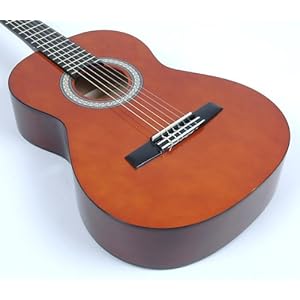
I was looking to get a 6 string guitar for playing. What I don't own (either here or have stored at my parents house) is a classical guitar and since it was a good choice for the type of playing in which I was interested, I decided to see what I could get on the cheap. On Amazon, I found an Valencia classical guitar (for $63 shipped including a bag). The review were good, so I decided to risk it.
I'm very impressed with the quality both in the appearance and sound, particularly considering how little this cost. Classical (nylon) strings take a lot longer to settle down than steel strings (partially because of how they are tied at the bottom), and it took about a week for the guitar to keep its tune well. I bought a $10 Snark tuner that clips onto the head of the guitar; I do have gStrings, an android phone app that works well, but I find the stand alone tuner is much more convenient.
Looking for music to play? It turns out, not surprising, that the internet is your friend. One of my favorite sites for finding music is tablatures.tk. This site has both text files as well as Guitar Pro tab files. The latter is much nicer, but you have to have a program that can read them (Guitar Pro costs $60).
Enter TuxGuitar. TuxGuitar is a brilliant open source software that reads Guitar Pro tab files.
It can handle multiple tracks, can transpose music, print out the tablatures, can play the music (in a very weird midi-voice, but that's good enough to figure out how it should sound). I highly recommend it. I've taught myself Greensleeves (pdf or gp3 files), relearning Pink Floyd's Is Anybody Out There (pdf or gp3 files), and even transposed the accompaniment of a few pieces to my daughters cello, such as Go Tell Aunt Rhody (pdf or tg files).
There is snow on the ground this weekend, so I did not get a chance to get out riding. I have gotten out a few times this year, but more on that in a future post.
I put the monkeys down for a nap and jumped on my bike and went for a nice 22 mile ride.
About half way into the ride, I realized that my bike wasn't handling very well at all. I stopped, and sure enough I had a flat rear tire. It took me about 15 minutes to get the tire changed (actually, it went pretty smoothly) and back on the bike.
With this ride, I am over 2,000 miles on my Cruzbike Sofrider in the 9½ months. It's definitely had it's ups and downs (particularly since there are hills here - ha ha!). I've ridden a bit more than 70 miles pulling my big monkey (or my nephew monkey) on the trail-a-bike, another 60+ miles pulling both of my monkeys in the trailer, and another 120+ miles pulling just the small monkey in the trailer (for just over 260 miles of pulling monkeys). Not bad for an old man.
Considering I probably haven't ridden a total of 2,000 in all previous years combined, I'm quite pleased. I have been very impressed with the Sofrider and definitely would recommend it.
My year-to-date stats on my Sofrider.
It's still been cold and dark in the mornings, so I haven't been biking into work. It certainly won't be light for a while, but I do have hope that we might get a break on the cold.
I have been lazy as far as commuting to work in the last couple weeks. It's always dark (even with the end of daylights savings time) and hasn't been above freezing in the mornings for several weeks now.
One problem that I've had with the cold are my extremities, my hands and my feet. The biggest problem with my feet is that I wear mountain bike shoes that aren't completely sealed on the bottom because of how the cleats attach. This is worse on a recumbent compared to a regular bicycle because my the bottom of my feet are basically facing forwards into the wind. I think I'll try lining the inside with plastic bags just to act as a wind barrier.
Today I went out for a quick 13 miler with it above freezing, but not by much (36 degrees Fahrenheit or 2 degrees Celsius). I wore two pairs of socks, two layers of long underwear under my tights, an undershirt, another long undershirt and long sleeve shirt under my jacket and ear muffs. I wore my long fingered bicycle gloves which are supposed to be wind and water proof, but aren't. But I wasn't worried about cold hands today.
I've seen a few pairs of bar mitts for sale in the past. I had two problems with them. First, they are expensive (these sell for $45). Second, I have bar end mirrors and I didn't see how that would work.
Recently on the winter forum on BikeForums.net, somebody mentioned scooter bike mitts for $16 (shipped). For that price, I was willing to experiment.
And I'm glad I did; it turned out well. I ripped out the seams near the corner and glued and sewed in velcro.
Bar mitt showing the velcro that I glued and sewed on the inside.
Same mitt with the velcro closed.
This allows me to slip the mitt over my mirror and then close the hole.
The bar mitt on my bicycle with the mirror poking through.
so clearly somebody in my family actually knows how to sew (and it isn't me). But the bar mitts worked extremely well and kept my hands nice and toasty warm. If it had gotten 5 degrees warmer, they would have worked too well.
It wasn't too weird riding with the mitts either. I do miss being able to see what gear I'm in (yes, I have indicators on my trigger shifters), but that wasn't too bad. I was able to get my hands out and signal and get them back in with no problems. And there were no issues with either shifting and braking. This experiment was definitely a success.
What a grand title. It sounds like I'll be talking about several months. Nope. Just this last week.
Most people have recovered from Sandy. Before the paint was even dry (or all the electricity was turned back on), we got hit by a Nor'easter storm. One friend of mine had his power restored for just over 36 hours before he lost it again (luckily it was restored that same night in his case).
With Sandy, we had very Fall weather. It rained a lot and the ground was covered with leaves. With the Nor'easter, we had several inches of snow. This was on Thursday of this week.
A photo from outside my work in the middle of the storm. Instant winter.
By Friday, the sun was back out shining and the snow was already starting to melt. The weather this weekend was (partly to mostly) sunny with a high of over 50 degrees on Saturday and into the 60s today. I didn't get a chance to ride to work this week, but was able to go out for rides both Saturday (yesterday) and today.
The same location at work a day later. What a difference a day makes.
Saturday was a nice ride. I put both my monkeys down for a nap and went out. I even managed to get back before they woke up.
I've been trying to explore new areas on the long rides and managed a new path for the end (although I think Andrew and I have ridden parts of this new path before). There were more hills than I would have liked in the latter part, but they're good for me, right?
At work this last week, I mentioned to Andrew that I'd love to get the big monkey out on one of our rides. We decided that he could pull the little monkey in the trailer and I'd take the big monkey on the trail-a-bike. While it probably takes less (leg) energy pulling the trail-a-bike, balancing it does take some practice, so it makes sense for me to pull it.
Today, Andrew came over and I had my comfort bike hooked up to the trailer, the trail-a-bike hooked up to my Sofrider, and two eager kids. We went just over 8 miles and everybody had a blast (I should have thought to take pictures, but I didn't). Andrew did very well for his first time out pulling a trailer (he has a very little monkey at home that will be ready for a trailer next season), but we did avoid the bigger hills in the area on his first outing. We stopped at the local park on the way back. My big monkey was o.k. with just a short time at the park (she'd been pedaling the whole time), but my little monkey wanted to stay longer. He was grumpy for a little bit, but wasn't too bad.
It was a good week. What an array of weather we've had here. So far, since February I have ridden my Cruzbike Sofrider 1915 miles. I very much want to hit 2000 miles by the end of the year and assuming the weather doesn't go crazy, I should be able to do just that. Of course, if the past couple weeks are any indication, I might be in trouble.
Due to many different circumstances, I haven't had as much opportunity as I would have liked to ride my bike since the Tour de Bronx 3 weeks ago. It all started off well enough. I took the Monday after the tour off to rest my legs. On Tuesday, the weather wasn't good so I skipped commuting by bike. On Wednesday, the stars aligned so I rode my bicycle to and from work. It was a short ride as I did my short routes both to and from work. But it was a good start after the tour.
On Thursday, October 21st I had every intention of riding my long route to work. As I was riding up Flax Hill, I noticed my derailleur occasionally grazing the spokes of the front wheel when I was in the biggest cog (lowest gear). As I made it to the top, I (very cleverly) decided to see if I could "fix" whatever was wrong. As it was still dark outside, I stopped under a street light and took a look. (If you're reading this wondering how I could be so, well, stupid, don't worry. You're not alone.)
To me, it looked as if the derailleur itself was slightly bent. So if I could apply just a little bit of pressure... SNAP! Oh, that didn't sound good. The derailleur was completely folded on itself. I tried to see if I could still pedal, but I couldn't turn the cranks more than a quarter turn before it jammed. The bad news was that I was still two miles from work and it was still dark. The good news is that after climbing Flax Hill, it was mostly down hill. So I "Fred Flinstone"d to work as best I could and locked the bike up.
I didn't want my bike to be out of service for too long, so that morning I ordered an SRAM X.9 long cage derailleur as well as a Cygolite Hotshot 2-Watt USB Rechargeable Taillight (of which I had read good reviews and of which I have nothing but good things to report; I recommend this tail light). I got the two items on Saturday and got to work Saturday night. When I got my bike on the workstand, I saw exactly what I had done. I hadn't actually broken the derailleur; I just managed to is detach the rear shifting cable so that the derailleur moved so far away from the bike that it was no longer possible for the chain to run through the bike. I could have returned the new derailleur I ordered, but since I had been toying with the idea of upgrading, I decided to install it. The old one was an SRAM X.5. With just about 90 miles on the new derailleur, I can't really tell the difference between the new one and the old one (part of me thinks the new one shifts better, but I can't decide if it really shifts better or I just want it to). In any case, I guess I now have a spare rear derailleur. On Sunday October 21st, it was a gorgeous fall day and I got to sneak out of the house and go for a ride while the monkeys were napping. My Garmin GPS wasn't charged, so I used my phone instead. This almost worked although it stopped recording four miles from home for some mysterious reason. Since it was such a beautiful days, I did stop at just about the half-way point to take pictures.
Where I'm going.
From where I came.
A nice example of a New England stone wall.
The week starting Monday, October 22nd did not give me many opportunities between the bad weather or having to take my corgi to the vet for minor surgery. I did manage to get 30 miles in two days commuting to work during the week and a very short 8 mile ride taking my little monkey to the park while his sister was at her cello lesson. At this point we knew Sandy was coming and I realized I wouldn't be riding for a while.
On Monday, October 29th, we already knew that school was cancelled for our monkeys. We had stocked up on water, candles, and food in preparation of the storm. I went to work and we were sent home just after noon. The weather looked gloomy but it was not yet raining; the radar showed a huge storm, but so far Norwalk was mostly being bypassed.
At 6 p.m. that night as there was light rain but heavy winds, Kate asked me if I knew where the flashlights were. "Yeah, yeah, I know. Don't worry about it." and as if on cue: Pop! No more power. Luckily I really did know where the flashlight was and was able to get it using the flashlight on my phone.
There were several people who stayed overnight at my work for fear that there nobody would be able to make it in the next day. It turns out that these concerns were not ridiculous. A friend of mine wanted to leave work at 7 p.m. to go home and eat dinner for a couple hours but was unable to get home and had to return back.
I left for work on Tuesday later than usual (since we had no good way to see in the house until the sun came up). Instead of my usual 8 minute drive, it took closer to 45 minutes. There were many roads blocked because of fallen trees and the wires that they brought down with them. The neighborhood in which my office is located was also without power. We have a generator to power our necessary computers at work, although not everything is powered.
The financial district in New York city soon after Hurricane Sandy hit (not my photo).
While we had food, our house (a rental) has an electric stove and electric oven. I do have a portable BBQ grill, but it is electric too. So while we have food, we had no way to cook it (for future events, I've ordered a camping gas stove that will be here soon). The roads became more and more passable, but up to Wednesday morning there was no evidence that there was any work being done to restore power (this is not meant as a critique; the problems were serious enough it makes sense to assess them before trying to fix them). The weather was getting colder and colder. Thursday night, we accepted a very generous offer from our friends (Thanks Diana and David!) to stay at their house since with no power, we had no heat. Our bags were packed and we were waiting for Kate to come back from our big monkey's cello lesson when our power came back on. As far as I can tell, Mother Nature decided that since we had effectively solved our problems (going to a place with heat; ordered portable gas stove), it was no longer as much fun to mess with us, so she let the electricity be turned on again.
Even in Norwalk, there are still many people without power (just over 10% still have no power almost a week later). And since we didn't get much rain here, we were actually very lucky. The flooding we had was due to storm surge and it would have been much worse if we had a couple of inches rain on top of that (which was in the original forecast). New York and New Jersey both have many places that were hit much worse than we were. So as annoying as it was to be without power for three days, we did not lose water and most of us did not sustain damage that was too bad.
Yesterday, my friend Andrew and I got out for a short ride. We had to take many detours of our planned route due to many crews actively working to clear fallen trees and get power restored. I got out myself for another nice ride today and found that several of the roads that were passable yesterday were closed today by crews. Hundreds of very old trees came down during this storm. It is going to be a while before the areas affected fully recover from this storm. The weather these last two days has been gorgeous - quite the contrast from the storm.
When my wife came home from a shopping trip, she told me there was a crew from Quebec just down the street. I walked down and thanked them for coming (they even understood my french!). We also heard of crews from such near by places as Massachusetts and as far away as Washington state.
I'm sure that if I were without power, I'd be less philosophical (and more bitter), but these events really do put things in perspective. Stay safe.
I should probably start by warning you that the title of this post is somewhat misleading. But never fear. All will reveal itself in good time (and probably not be worth the build up I'm currently giving it).
Since my last blog entry three weeks ago, I had been sick and got very little riding in. I had been hoping to ride the 40 mile Tour de Bronx, but was getting quite worried that I wasn't going to be healthy enough in time. Last Friday (four days ago), I was finally well enough to get back on the bike and got almost 17.5 miles commuting to and from work. This was by far not the fastest ride I have ever done, but both the morning and afternoon rides themselves went well.
As it is now fall and daylight savings time has not yet ended, I start out my commutes in the dark. About half way into my Friday ride, the sun was finally coming up and I stopped to get a picture of the sunrise.
The sun rising over the Long Island Sound.
When I got of my bike to take a picture, I realized how quiet it was. All I could hear was the ocean. I enjoyed it enough that I took a short (10 second) video where really the only interesting thing is the sound.
Short video where you can hear the ocean. Corny, but I like it.
A few posts ago, I mentioned a technique called bridging. This is basically where I plant my shoulders against the rear of the seat and lift my butt off of the seat while pushing on the pedals. This technique allows me, for a short period of time produce a lot of power and either really zoom ahead if I am riding on a flat bit of road or zoom up short but very steep hills.
This is a technique that many recumbent riders use. Reading about it, it sounds like this is usually done on bicycles with a lower seat angle than I have on my Sofrider - I have heard you need an angle of 30 degrees from horizontal or less (my Sofrider angle is closer to 45 degrees). While I was on my commute ride, I realized that when I am bridging, I am also pushing myself up against the handlebars.
The reason this is relevant is that unlike upright (err.. regular) bicycles, on most recumbents they are not designed to support much stress on the handle bars at all. Cruzbikes, because they are front wheel drive that have the bottom bracket (where the pedals are attachted) that swings with the front wheel, have handlebars that can sustain much more force. Without well braced handlebars, I wouldn't be able to bridge on a rear wheel drive recumbent.
Back, to our regularly scheduled blog entry, I hadn't gotten the miles I would have wanted for the last three weeks, but the ride went well enough that I thought I was ready for the Tour de Bronx on Sunday (two days later).
One of the 'Bent Rider Online Forum readers, Pat, posted about the Tour de Bronx and organized a meeting for recumbent riders. One difference about this ride compared to others I have done in the past is that the start and the end of the ride were not at the same place. Pat was clever enough to tell everybody to park at the end. So following his directions, I was at the meeting point with by bike put back together and ready to go with 30 minutes to spare. The weather was cool and it was drizzling slightly. The rain stopped completely within 30 minutes and never came back.
I was the first recumbent rider there, but most definitely not the last. The second to arrive also lives in Norwalk (how's that for a nice coincidence!). Within 30 minutes, I saw more recumbent bicycles in one place than I have ever seen before in my life. Long wheel base recumbents, short wheel base recumbents, some with under seat steering. There was even a family that showed up where the teenage sons rode mountain bikes and the parents rode tandem recumbent.
We left the parking lot as a group around 9:30, arrived at the start around 10:15 where we had to pick up our event numbers. The start was so busy that we got separated. A handful of us found each other and were (almost) ready for the start at 10:30.
Andrew and I rode the Bloomin' Metric Century in May, this was the most bicycles I ever saw at one place. We were also impressed at how homogeneous a group of people were riding that event. Almost everybody was fully spandexed, riding a road bicycle where I estimated that the average bike there probably cost around $2,000.
The Tour de Bronx was much more heterogeneous, both in terms of the racial make up of the event, but also in terms of the bicycles. There were many many fully spandexed riders here on nice road bikes. Unlike the Bloomin' Metric, I saw several folding bicycles, a lot of fixed gear bicycles, a few pre-teen children riding mountain bikes with knobby tires, and even a BMX bicycle with 20" wheels and no gears. Most bicycles seemed to be working fine, but the average bicycle price was well less than the Bloomin' Metric. And where as the Bloomin' Metric Century was capped at 2,500 riders, this news paper sets the attendance at more than double at 6,000 riders. There were several places where I was not able to ride as quickly as I would have liked because it was so crowded. The atmosphere of this event was unlike that of any I have yet ridden.
A view of the first rest stop.
At about 14 miles (including our trip to the start), we got to the first rest top. It was crazy busy, but there weren't problems getting food. Pat knew about a "secret toilet"; otherwise it would have taken 30 minutes just to visit the facilities. I was supposed to meet the rest of the recumbent riders outside the rest area, but I lost them and continued on by myself.
During the ride, the sun came out in full force. In between the first and second stop, I pulled over in some woods to change my pants into shorts and remove two long sleeve shirts. I was very well served having my Camelbak water bladder attached to my bicycle.
The route for this tour (as you can see below) really was all over the Bronx. It was nice getting back to City Island (to where Andrew and I rode in April).
The Tour de Bronx Ride. Since I started recording in the parking lot, the start and the stop are the same on my recording, which was not true of the actual ride.
As the ride progressed, the population of bicycles got thinner and thinner. At the beginning of the ride, the police closed several streets and were directing traffic to allow the hoards of bicycles through. Several spectators came out to cheer us on our way, and as usual, children really enjoyed seeing my recumbent bicycle - when we were a group of recumbents the reaction of the crowd was often quite lively. After the third rest stop, the marshals that had been ever-present became quite rare indeed. Within a mile after the last stop, the group of bicycles I was with no longer knew where to go and we were officially lost. Between miles 43.5 and 44.5, I rode up a large hill (yes, they do really exist in the Bronx), just to realize that that wasn't the right way and to ride back down.
Because my GPS records a path of where I had been and because Pat was ever so clever (thanks Pat!) to tell us to park at the end, I effectively had a very good compass to help me get back to my car. At mile 45, with another rider following me, we came across a large steep hill. She stopped at the bottom to walk up; I rode up 1/3 of the way before I quit. The hill was definitely climbable, but I was tired enough that I just didn't want to push it.
A few miles before the end, I picked up a group of a half a dozen riders who were also lost relying on my GPS to get us back. We made it back largely without incident, although I'm willing to believe that the official route would have been on much less busy streets. I'll be curious to see if I can find the GPS track from somebody who rode the ride correctly so I can compare it to mine to see where (and how badly) I got it wrong.
As promised, I've covered everything the title of the post said I would, albeit not necessarily as expected.
It was a long three weeks getting over my cold. I'm not completely better, but I'm much better off and very glad that I was able to ride "the tour."